
They sit above the paid results, above the map, above everything. Your competitor has a green check mark next to their name and you do not. The obvious conclusion is that you are losing work to that badge, and the obvious response is to go and get one.
Both of those may be right. It is still worth understanding what the badge actually certifies before you decide what it is worth.
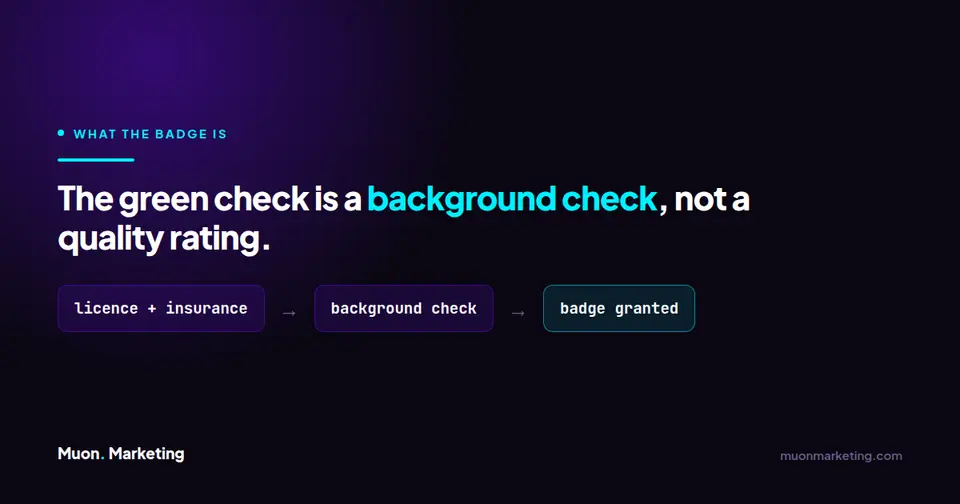
The green badge is a background check, not a quality rating
Google Guaranteed is awarded after a screening and verification process covering licence, insurance and background checks on the business and, depending on the category, its field staff. Google publishes the screening requirements by job type and location and they vary considerably between categories. What matters for your decision is what that process does not assess.
It does not rate the quality of your work. It does not compare you against the contractor next to you. It is a verification that you are who you say you are and that you carry what you claim to carry. Homeowners frequently read it as an endorsement, which is precisely why it converts, but you should not confuse the market perception with what Google is actually asserting.
That distinction matters because it tells you what the badge is worth to a business that is already legitimate, insured and licensed. You are not buying credibility you lack. You are buying a visual shorthand for credibility you already have, in a position on the page where it gets seen.
How the billing differs from Google Ads
This is the part contractors most often get wrong, because the two products look similar and bill on completely different events.
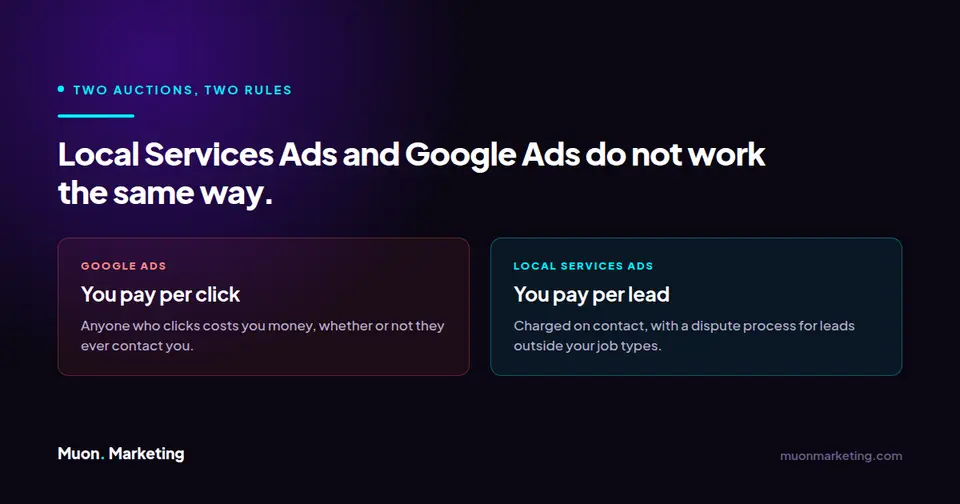
Google Ads charges you per click. Somebody who taps your ad, reads for four seconds and leaves has cost you money. Local Services Ads charges you per lead, meaning per call or message that comes through the unit. Somebody who sees the ad and does not contact you costs nothing. Yelp bills the other way, per click rather than per contact, which is why a Yelp price and a Local Services price cannot be compared directly.
That sounds strictly better and often is, but it changes what you have to watch. Under a per lead model your exposure is concentrated in lead quality rather than click volume, so the dispute process becomes the thing that decides your effective cost. Google provides a route to dispute leads that fall outside your job types or service area. Use it consistently rather than occasionally, because a lead you did not dispute is a lead you agreed to pay for.
The arithmetic, which is the same as everywhere else
Whatever the platform, the number that decides it is not the price of a lead. It is the price of a lead divided by the share of them you convert, because you pay for the ones you lose as well as the ones you win.
| Your close rate | Leads per job won | At $40 a lead | At $80 a lead | At $150 a lead |
|---|---|---|---|---|
| 1 in 2 | 2 | $80 | $160 | $300 |
| 1 in 3 | 3 | $120 | $240 | $450 |
| 1 in 4 | 4 | $160 | $320 | $600 |
| 1 in 6 | 6 | $240 | $480 | $900 |
Local Services Ads leads generally convert better than shared marketplace leads, for a straightforward reason: the customer contacted you directly rather than submitting a form that went to four companies, which is the whole shared against exclusive lead argument in one sentence. Do not assume that improvement, measure it. Track your close rate on this channel separately from every other channel for at least a quarter before you scale the budget.
Where it genuinely fits well
It fits emergency and near emergency trades best. Locksmiths, restoration, garage doors, plumbing and anything else where the customer is calling rather than researching. The unit is built around a phone call, it sits at the very top of the page, and the searcher in those categories is not comparing five websites.
It fits businesses that are already properly licensed and insured, because the screening is then a formality rather than an obstacle.
It fits less well where the decision is slow and considered. A homeowner planning a kitchen renovation over six months is not going to call the first result and book. For that work the money is usually better spent on the content that reaches them during the research, which is the argument we set out on the general contractor page.
What to do before you switch anything on
Get the profile right first. Local Services Ads draws on your reviews and your business information, so turning on spend before the underlying profile is complete is paying to amplify something unfinished.
Then decide what a lead is worth to you using the table above and your own job values, and set the budget from that figure rather than from what you can afford. Those are different numbers and confusing them is how contractors end up spending a season discovering their cost per job.
For a comparison point, since almost nobody publishes one: our performance model is $195 a month plus $10 to $65 per qualified lead depending on the trade and the market, where qualified means a tracked call or form submission meeting a definition agreed in writing before we start. Whatever you pay, on any platform, get that definition in writing and find out what happens when a lead does not meet it.
The wider question of renting visibility against owning it is the same one behind pay per lead versus a monthly retainer, and the method we use either way is on the local SEO service page. If you are already paying somebody and cannot tell whether it is working, there is a way to check without asking them.
Local Services Ads FAQs
Are Google Local Services Ads worth it?
For emergency and call driven trades, usually yes, provided you already hold the licences and insurance the screening requires and you dispute unqualified leads consistently. For slow considered purchases like renovations, the money often works harder on content that reaches people during the research phase. The deciding number is your cost per lead divided by your close rate on that channel specifically, measured rather than assumed.
What does the Google Guaranteed badge actually mean?
It means the business passed a screening covering licence, insurance and background checks, with requirements that vary by job type and location. It is a verification of identity and credentials, not an assessment of the quality of your work and not a comparison against competitors. Customers often read it as an endorsement, which is why it converts, but that is market perception rather than what Google is asserting.
How is this different from Google Ads?
Google Ads charges per click, so a visitor who reads for four seconds and leaves costs you money. Local Services Ads charges per lead, meaning per call or message through the unit, so someone who sees it and does not contact you costs nothing. The trade off is that your exposure moves from click volume to lead quality, which makes the dispute process central rather than incidental.
Can I dispute a bad lead?
Yes. Google provides a route to dispute leads falling outside your job types or service area. Treat it as routine rather than exceptional, because a lead you did not dispute is a lead you have accepted and will pay for. Contractors who dispute consistently report a materially different effective cost from those who only do it when annoyed.
Do I need reviews before starting?
You should have them, yes. The ad unit draws on your review profile and your business information, so starting spend before that is complete means paying to amplify something unfinished. Finish the profile, build a review habit into the end of each job, then switch on the budget.
Should I run Local Services Ads and SEO at the same time?
Usually yes, because they solve different problems. The ads produce work this month and stop the day you stop paying. Search compounds slowly and keeps producing. The sensible pattern for most trades is paid for immediate capacity and search built underneath it, so that the paid budget is not the only thing holding your position.