
Somebody quotes you forty dollars a lead. Is that good? The honest answer is that the question cannot be answered from the outside, and any salesperson who answers it confidently is guessing about your business or hoping you will not check.
A lead price is only ever expensive or cheap relative to two numbers you already have: what a job is worth to you after costs, and how often you turn an enquiry into one. Get those two numbers and the ceiling falls out in about five minutes.
There is no market rate, and the platforms say so
Every major platform describes lead price as something set by competition and circumstance rather than by any fixed schedule. Thumbtack says the cost of a lead varies with the type and size of the job, how many pros are available and your market. Google describes a Local Services bid as the most you would pay for a lead, with competing local businesses bidding on the same lead determining what it is worth.
That is worth sitting with, because it means price is a signal about demand from other contractors and not a signal about how good the lead is. A dear lead is dear because your competitors want it too. It is not dear because the customer is more likely to buy. Whether it reaches you alone or alongside three competitors is a different question again, taken up in shared leads versus exclusive leads.
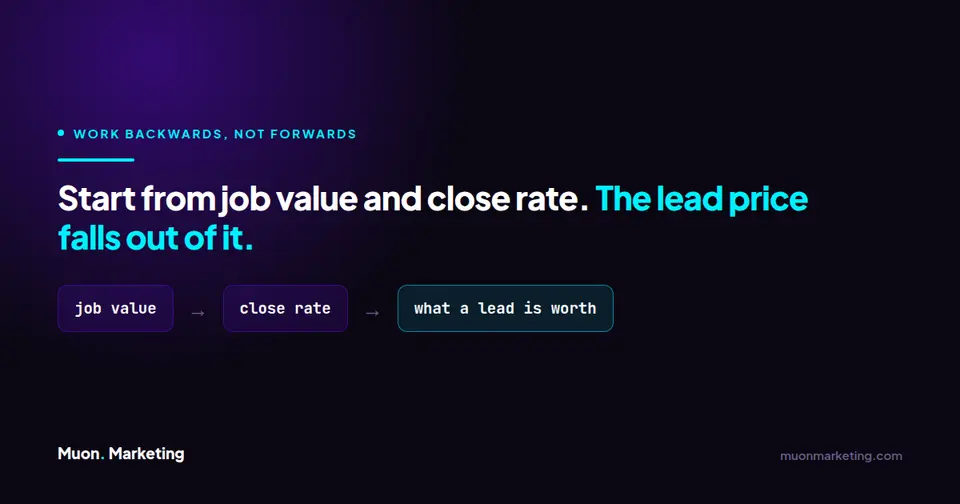
Work backwards, in four numbers
Start with the average value of the job you are trying to buy, not the average of all your work. Take your gross profit on it, which is what is left after materials and labour but before overhead. Decide what share of that profit you are willing to hand over to win the job. Then divide by your close rate.
Those four numbers produce a ceiling. Anything below it is worth testing; anything above it is a loss you have not noticed yet. Here is the shape of it at a forty percent gross margin, spending a fifth of gross profit to win the job.
| Average job | Gross profit | Acquisition budget | Max lead price, 1 in 3 | 1 in 5 | 1 in 10 |
|---|---|---|---|---|---|
| $300 | $120 | $24 | $8 | $4.80 | $2.40 |
| $800 | $320 | $64 | $21 | $12.80 | $6.40 |
| $2,000 | $800 | $160 | $53 | $32 | $16 |
| $6,000 | $2,400 | $480 | $160 | $96 | $48 |
| $15,000 | $6,000 | $1,200 | $400 | $240 | $120 |
Two things jump out of that table. First, the close rate does more damage than the price. Moving from one in three to one in ten cuts what you can afford by two thirds, and nothing about the platform changes it. Second, a small ticket trade genuinely cannot pay much for a contact, which is why cleaning companies and roofers should never take each other’s advice about lead buying.
If you would rather not do the arithmetic by hand, the ROI calculator runs the same shape of calculation.
Cost per lead is a target, not a promise
Even when a platform lets you set a target, it is an average and not a guarantee. Google is explicit about this for its own bidding: some conversions cost more than your target and some cost less, and the system aims to land the average on the number you set. It also names the things that push actual cost away from target, including increased competition in the auction and changes on your own site.
Take the same view of any per lead quote you are given. Judge it over thirty or fifty leads, not over five. Five leads is noise, and it is enough noise to talk yourself into or out of almost anything.
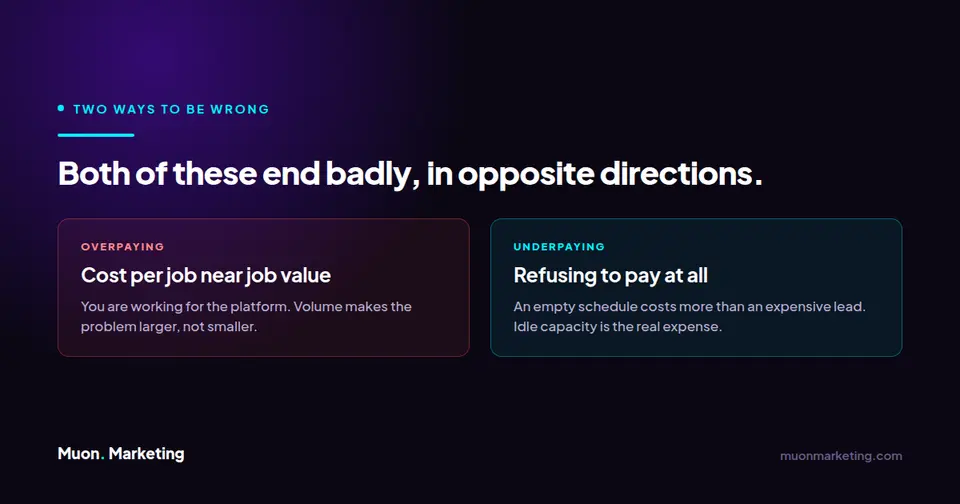
Both mistakes cost money
Overpaying is the obvious failure and the easier one to spot, because it shows up on a card statement. The quieter failure is refusing to pay a price that your own numbers say is fine. A contractor with a $6,000 average job and a one in three close rate can pay well over a hundred dollars a lead and still be comfortably ahead, and will often reject a sixty dollar lead as too expensive because it sounds like a lot of money.
It sounds like a lot because we compare lead prices to other lead prices instead of to the job. It is the same error behind putting a Yelp click price next to an Angi lead price as though they were the same unit. That is also how you end up buying cheap contacts in volume, staffing up to answer them, and wondering why the calendar filled but the bank account did not.
What we charge, and why it is a range
For the sake of not being coy about it: our performance model is $195 a month plus $10 to $65 per qualified lead, and where you land in that range depends on the trade and the market. A cleaning lead in a small Ohio town and a restoration lead in a competitive metro are not the same product and should not carry the same price. Full detail is on the pricing page.
The reason to publish a range rather than a single number is the same reason this article exists. A flat per lead price across every trade would mean somebody is overpaying to subsidise somebody else, and it would usually be the small ticket trades subsidising the large ones.
The number that actually moves
Of everything above, the close rate is the one you control. Answering the phone with a person, replying inside the hour, and sending a quote that explains itself will shift it further than any negotiation over price per lead. Fix that first, and every lead source you have becomes cheaper on the same day.
It is also worth remembering that bought leads are rented and stop when the payments stop, which is the trade off set out in SEO retainer versus pay per lead. Owning the position through local SEO takes longer to start and does not switch off. Most established contractors end up running both, and which one to start with comes down to the constraint you actually have. The arithmetic above is how you decide how much of each.
Lead Pricing FAQs
How much should a contractor pay for a lead?
Whatever your own numbers support. Take the gross profit on the job you are buying, decide what share of it you will spend to win the job, and divide by your close rate. That gives your ceiling. For a $300 job at a 40 percent margin closing one in five it might be under $5; for a $6,000 job at the same margin and one in three it can exceed $150.
What is a good cost per lead for home services?
There is no single figure, and any quoted industry average hides the two variables that decide it: your average job value and your close rate. A price that ruins a cleaning company is comfortable for a roofer.
Why do lead prices vary so much between platforms and areas?
Because they are set by competition rather than by a schedule. Platforms describe lead price as depending on the type and size of the job, how many businesses are available and competing, and the market. Price reflects demand from other contractors, not the quality of the customer.
How many leads do I need before I can judge a source?
Thirty at a minimum, and fifty is better. Five leads is noise. Judge on cost per job won rather than cost per lead, and give the source enough volume to produce a real close rate rather than an accident.
Is it better to raise my close rate or lower my lead price?
Raise the close rate. It is the number you control, it improves every lead source you run at once, and it usually moves further than a price negotiation. Answering fast with a person and quoting clearly are the two levers that do most of the work.
How much does Muon Marketing charge per lead?
Our performance model is $195 per month plus $10 to $65 per qualified lead, with the per lead figure depending on the trade and the market. Pricing detail is on our pricing page.