
Two quotes land on your desk. One sells contacts at a price that makes you blink at how low it is. The other wants several times that for what it calls an exclusive lead. The cheap one is not obviously the cheap one, and the expensive one is not obviously a rip off. It depends entirely on a number neither salesperson will ask you for.
That number is your close rate, and the two models are really a bet about it. Shared leads bet that volume beats conversion. Exclusive leads bet the reverse. Only one of those bets fits how your business actually sells.
What the two words actually mean
A shared lead is a customer enquiry sold to several businesses at once. You are all notified, you all pay, and you are all racing. An exclusive lead is sold to one business, which is you. The distinction sounds like a feature list and it is really a description of what you will spend your day doing.
Platforms differ in how they describe this, and it is worth reading their own words rather than a sales deck. Google says a Local Services lead reaches you directly as a call, a text or an email and that you are charged for each valid lead received. Thumbtack describes its leads as customers who reach out to you directly and charges when that happens. Neither of those descriptions tells you how many other businesses received the same customer, which is exactly the question to ask in writing before you fund anything. The platform by platform verdicts are separate pieces: Angi Leads, Thumbtack and Google Local Services Ads.
It is a question worth asking directly because lead matching has been the subject of enforcement. In 2023 the Federal Trade Commission ordered HomeAdvisor to pay up to $7.2 million over how it marketed its leads, alleging among other things that service providers did not always receive leads matching the services they provide and their preferred area, and that the company described job conversion rates it could not substantiate. Whatever a platform tells you about lead quality, treat it as a claim to verify rather than a specification.
The only comparison that means anything
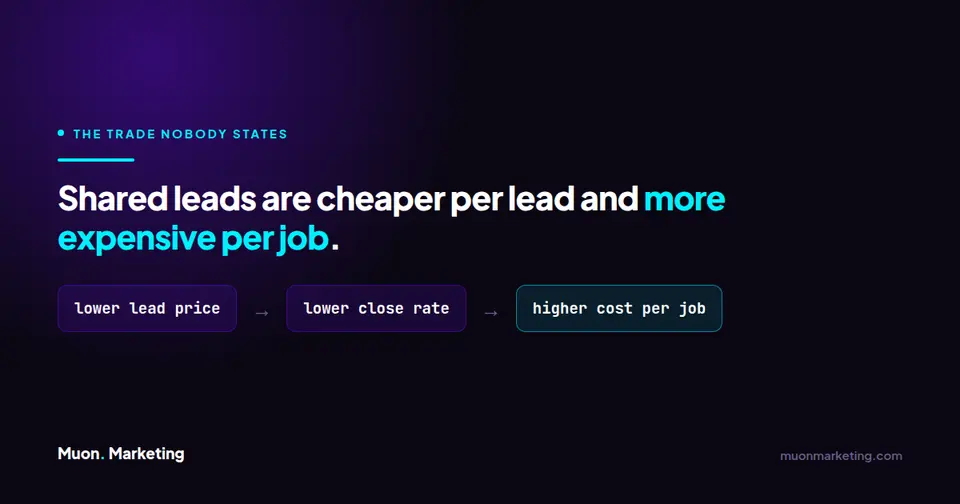
Cost per lead is not cost per acquisition. Divide the price by the share of leads you convert and you have the real number. Do that for both quotes and the argument usually resolves itself in about two minutes.
Run it the other way round and it becomes a sharper tool. Pick the cost per job you are willing to pay, then read off the close rate that each lead price is quietly demanding of you.
| Price per lead | Leads per job at a $150 target | Close rate that requires |
|---|---|---|
| $10 | 15 | about 7 in 100 |
| $20 | 7.5 | about 13 in 100 |
| $35 | 4.3 | about 23 in 100 |
| $50 | 3 | 1 in 3 |
| $75 | 2 | 1 in 2 |
| $120 | 1.25 | 4 in 5 |
Look at the bottom two rows. A high priced exclusive lead is only sane if you close at a rate most contractors do not, and the platforms selling them know that. The general method for setting that ceiling is in how much a lead should cost. Look at the top row and the trap is the mirror image. Seven closes in a hundred sounds easy until you count the hundred phone calls.
What each model asks of you
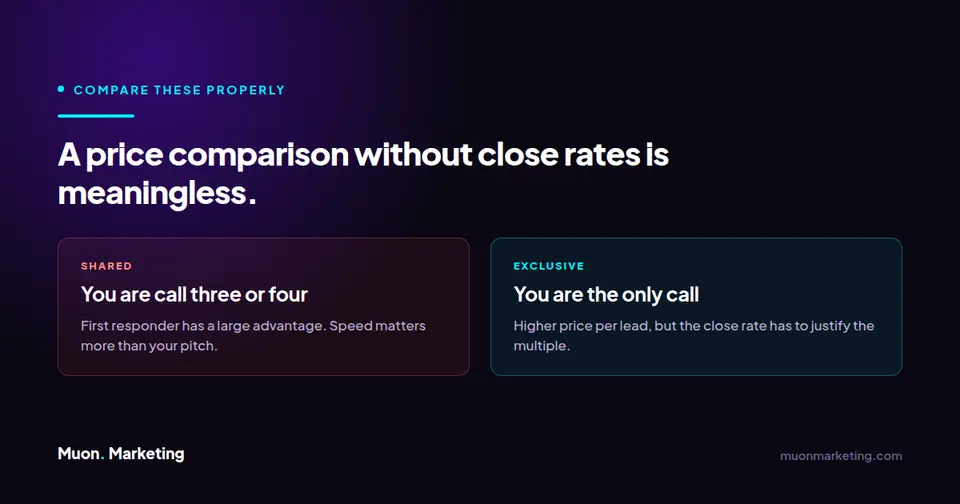
A shared lead is a speed business. The customer contacted several companies in one action, and in most cases the first credible response gets the conversation. If your phone is answered by a person during working hours and somebody replies within minutes rather than hours, shared leads can work. If enquiries sit until the end of the day because you are on a roof, you are buying conversations that were finished before you opened them.
An exclusive lead is a conversion business. Nobody is racing you, so the price is buying you the time to do a proper job of the conversation. That only pays if the conversation is good. If your quoting is slow, your follow up is thin, or you send a number with no explanation attached, you will pay premium prices for the same outcome you were getting cheaply.
Google is fairly open that the price itself is set by competition rather than by any measure of quality. Its documentation describes a bid as the most you would pay for a lead, with competing local businesses bidding on the same lead determining what that lead is worth. Price signals demand. It does not signal that the customer is serious.
Which trades suit which
Shared tends to suit small ticket, fast turnaround, low consideration work where the customer wants somebody today and is not running a selection process. Cleaning, pest control and lock work sit there. Exclusive tends to suit larger tickets where a site visit is part of the sale and the customer expects a considered proposal, which is where roofing and general contracting sit.
The exception worth naming is the busy shop. If you are already at capacity, shared leads are actively bad value, because the thing you lack is not enquiries but time to answer them. Paying less per lead to lose more races is a way of turning money into notifications.
Test it without a season long commitment
Buy the smallest volume the platform will sell. Track three numbers only: what you paid, how many became real conversations, and how many became invoices. Log the time between the notification arriving and your first response, because on shared leads that single number will explain most of your result.
Give it enough leads to mean something rather than enough weeks. Thirty contacts tells you more in a busy fortnight than ten contacts tells you in two months. Then compare cost per job against every other channel you run, on the same page, in the same units.
What neither one builds
Both models are rented demand. The day you stop paying, both stop, and neither leaves anything behind that keeps working. That is not a reason to avoid them, and for a new business it is often the correct first move. It is a reason not to let them be the whole plan. The trade off is set out in full in SEO retainer versus pay per lead.
The alternative is owning the position instead of renting the contact, which is what local SEO for contractors is for. It is slower to start and it does not stop when the invoice does. If somebody is already doing that work for you and you cannot tell whether it is working, there are three things you can check without asking them.