
A call from Yelp, then an email, then a rep with a monthly number already in mind. If you sell home services you have had that conversation, probably more than once. The pitch is not dishonest. What it leaves out is that Yelp sells a different unit from the lead platforms you are mentally comparing it against.
Yelp sells clicks. Angi, Thumbtack and Google Local Services sell contacts. A click price that looks cheap next to a lead price is usually not cheap at all, because two conversion steps sit between the click and the booked job instead of one.
Yelp charges for clicks, not for customers
Yelp states the mechanism in its own help centre. Under the cost per click programme you are billed for the clicks you received during the monthly billing period, and the platform tries to spend the whole budget you set. Somebody tapping your ad and closing the tab two seconds later is a billable event. Somebody who reads your page, likes you and calls next Tuesday from a saved number may never register as a click at all.
The price of each click is not fixed. Yelp describes it as a dynamic auction shaped by how many similar businesses are competing, how much ad inventory exists and how much consumer interest there is, so the price moves with supply and demand at that moment. In practice that means your quiet months are cheap and your busy months, when every competitor is also bidding, are dear. Yelp does say you pay the least amount needed to win the click, which is true and is also how every auction works.
None of this is a scandal. It is simply an advertising product with an advertising product’s economics, and it should be judged the way you would judge a billboard or a truck wrap rather than the way you judge a lead invoice.
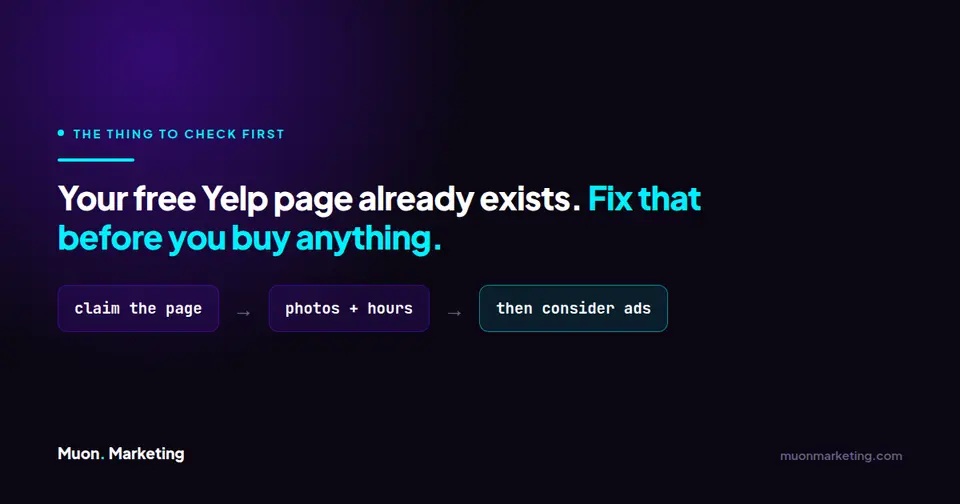
Claim the free page before you buy anything
This is the step contractors skip, and it is the one with the best return. A Yelp business page costs nothing. Yelp lists it as a free product with more than twenty free features, separate from the paid ad packages, and it ranks in ordinary Google results for your name and often for your category as well.
A claimed page with correct hours, real photographs of your own crews and a steady trickle of reviews will produce calls whether or not you ever spend a dollar on ads. Buying ads to point at a thin, unclaimed page is paying to send people somewhere that does not convince them. Fix the destination first, then decide about traffic.
The arithmetic, at click prices instead of lead prices
Two rates decide whether Yelp pays. The share of clicks that turn into an actual enquiry, and the share of enquiries that turn into booked work. Multiply them and you get clicks per job, which is the only number that matters.
| Clicks per enquiry | Enquiries per job | Clicks per job | At $3 a click | At $6 a click | At $12 a click |
|---|---|---|---|---|---|
| 1 in 5 | 1 in 3 | 15 | $45 | $90 | $180 |
| 1 in 8 | 1 in 3 | 24 | $72 | $144 | $288 |
| 1 in 8 | 1 in 5 | 40 | $120 | $240 | $480 |
| 1 in 12 | 1 in 5 | 60 | $180 | $360 | $720 |
Run your own numbers rather than these. The point of the table is the shape, not the values, and the ceiling those numbers imply is worked out in how much a lead should cost. A click price you would happily pay becomes an acquisition cost you would refuse the moment the enquiry rate drops, and the enquiry rate is the number almost nobody tracks.
Where it works, and where it does not
Yelp skews consumer, urban and reactive. It works best where the customer is comparing several nearby options for a job they want done soon, the ticket is small enough to decide without a site visit, and reviews carry most of the persuasion. House cleaning, carpet cleaning and locksmith work sit squarely in that description.
It works worst where the job is large, the decision is slow, and the customer wants to meet you before they commit. For a roof replacement or a whole house remodel, a click is a very early signal and a great many of them are people who will not buy from anyone for months. You will pay for all of that browsing.
Geography matters more here than on the lead platforms. Yelp usage is heavily concentrated in large metros and on the coasts. In a small Ohio market the inventory may simply not exist in your category, which means low spend and low return rather than wasted money, but it also means Yelp is unlikely to be the thing that fills your calendar.
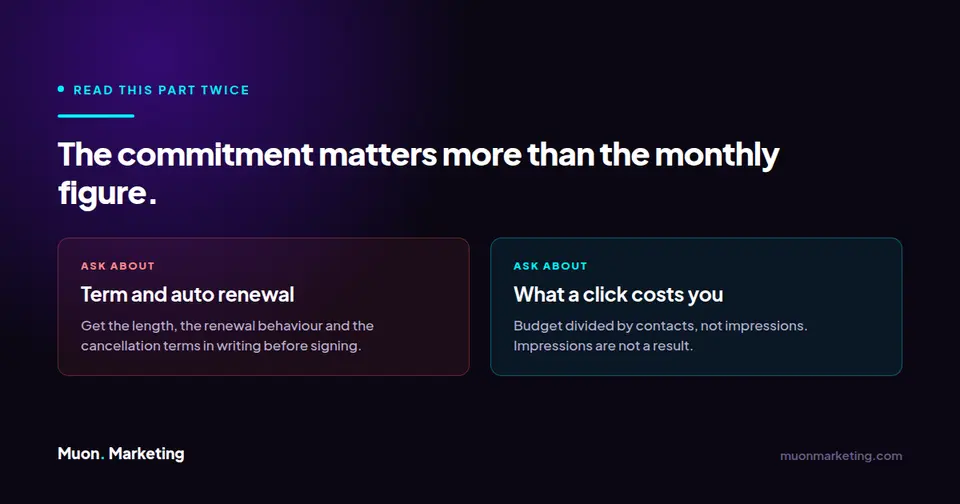
What to check before you sign
Get the term length in writing. Get the cancellation terms in writing. Get confirmation of whether the monthly figure is a budget you spend down or a fee you pay regardless. Ask whether any part of the package is an upgrade product rather than advertising, because Yelp sells both and they are billed separately.
Then set a review date before you start, not after. Ninety days is enough to see a pattern in a seasonal trade. Write down today what result would make you renew, because the version of you three months from now, looking at a dashboard full of impressions, will find a reason to hold on.
What it does not build
Every click you buy is rented. Stop paying and the traffic stops the same week, and nothing you paid for stays behind. That is not an argument against advertising, which is often the right answer when you need work now, but it is the reason advertising should not be the only thing you do, and which of the two you start with depends on the constraint you actually have. The comparison is laid out at length in SEO retainer versus pay per lead.
The alternative is owning the position rather than renting it. A page on your own site that ranks for the work you want keeps producing after the invoice stops, which is the whole argument for local SEO for contractors. It is slower and it does not switch on in a week. If you are already paying somebody for it and cannot tell whether it is working, there are three things you can check yourself.
Yelp Ads FAQs
How much do Yelp Ads cost for a contractor?
There is no fixed price. Yelp bills per click and sets the price through an auction that moves with how many similar businesses are competing, how much ad inventory is available and how much consumer interest there is at that moment. Your monthly figure is a budget Yelp tries to spend in full, not a fixed cost per customer.
Do I have to pay to be listed on Yelp?
No. A claimed Yelp business page is free and includes more than twenty features. Advertising is a separate paid product. Claim and complete the free page before you consider buying ads, because ads only send people to that page.
Does Yelp charge per click or per lead?
Per click. This is the main difference between Yelp and platforms such as Angi, Thumbtack or Google Local Services Ads, which charge when a customer contacts you. A click is an earlier and weaker signal than a contact, so a Yelp click price should never be compared directly with a lead price.
Which trades do Yelp Ads work best for?
Consumer facing work with a small to mid sized ticket that the customer wants done soon, in a metro where Yelp is widely used. Cleaning, carpet cleaning, pest control and locksmith work fit that shape. Large, slow, high consideration jobs such as roof replacement or full remodels fit it poorly.
Can I control what I pay per click on Yelp?
Not directly. You set a monthly budget and Yelp runs the auction. You influence the effective cost by improving what happens after the click, which means a complete page, current photographs and recent reviews, so that fewer clicks are needed per enquiry.
Are Yelp Ads better than Google Ads for contractors?
It depends on where your customers search. Google captures people actively looking for a service; Yelp captures people comparing nearby businesses within Yelp itself. In most small and mid sized markets Google reaches more of the demand, and in dense metros with strong Yelp usage the two can both be worth testing. Test one at a time so you can tell which produced the work.