

You funded the account, the notifications started, and a fortnight later the balance is lower than you expected and the calendar is not much fuller. Nothing went wrong exactly. The product did what it says it does.
The question is whether what it does suits the kind of work you sell, because for some trades it clearly does and for others it clearly does not. The same question applied to Angi Leads and to Google Local Services Ads produces different answers again.
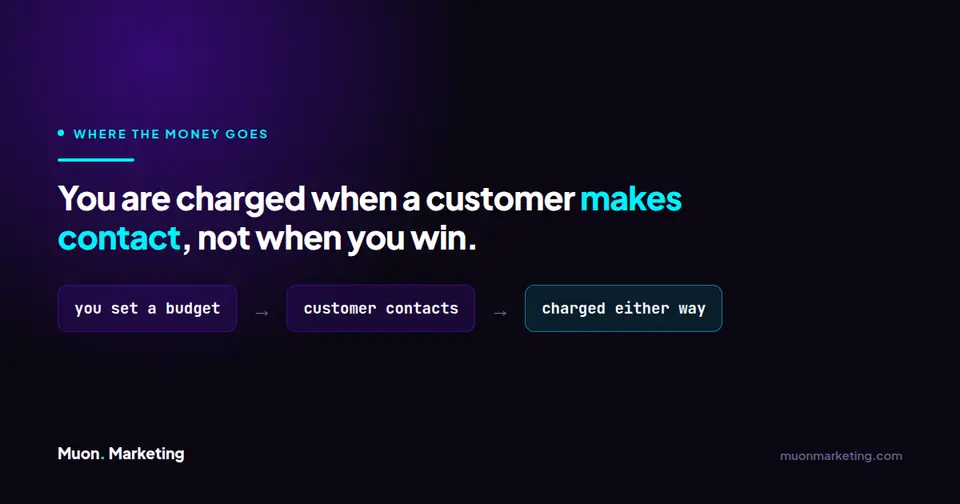
You are charged on contact, not on winning
This is the mechanism everything else follows from. When a customer reaches out through the platform, that is the billable event. Whether you win the job, whether they reply to your reply, whether they were ever serious, the charge has already happened.
Thumbtack states the mechanism in its own documentation. When a customer reaches out to you directly from search results and the job matches your job preferences, you auto-pay for that lead. The price is not a flat rate either. Thumbtack says it varies with the type and size of the job, how many pros are available, and your market.
It is not a hidden term and Thumbtack does not pretend otherwise. It is simply a very different model from paying a commission on completed work, and contractors who mentally price it as a commission are the ones who get a shock. You are buying conversations, and you are buying all of them, including the ones that end after one message.
The practical consequence is that your cost is driven by how many people contact you, which is only loosely connected to how many jobs you get. In a slow week that relationship can be uncomfortable.
Refunds exist, but they are not a safety net you can budget around. The refund policy for pros refunds some situations automatically, handles others case by case, and states that all refunds are made at Thumbtack’s sole discretion.
The arithmetic, before you fund anything
Same calculation as any lead source. The price of a contact is not your acquisition cost. Your acquisition cost is that price divided by the share of contacts that become paid work.
One billing detail is worth knowing before you fund anything, because it changes how the spend feels. Until your lifetime spend on the platform reaches $1,000, you are charged for each lead separately as it arrives. After that, leads are charged in bulk, on a day you choose or once you have accrued $50 in lead charges, whichever comes first.
| Contacts you convert | Contacts per job won | At $15 a contact | At $30 a contact | At $60 a contact |
|---|---|---|---|---|
| 1 in 3 | 3 | $45 | $90 | $180 |
| 1 in 5 | 5 | $75 | $150 | $300 |
| 1 in 8 | 8 | $120 | $240 | $480 |
| 1 in 12 | 12 | $180 | $360 | $720 |
Put your own figures in and be honest about the conversion column, because it is usually worse than people assume. Messaging platforms attract browsing behaviour that a phone call does not, so a meaningful share of contacts are people gathering quotes with no near term intention of hiring anybody. Working out what a lead should cost you from your own job value gives you a ceiling to test that against.
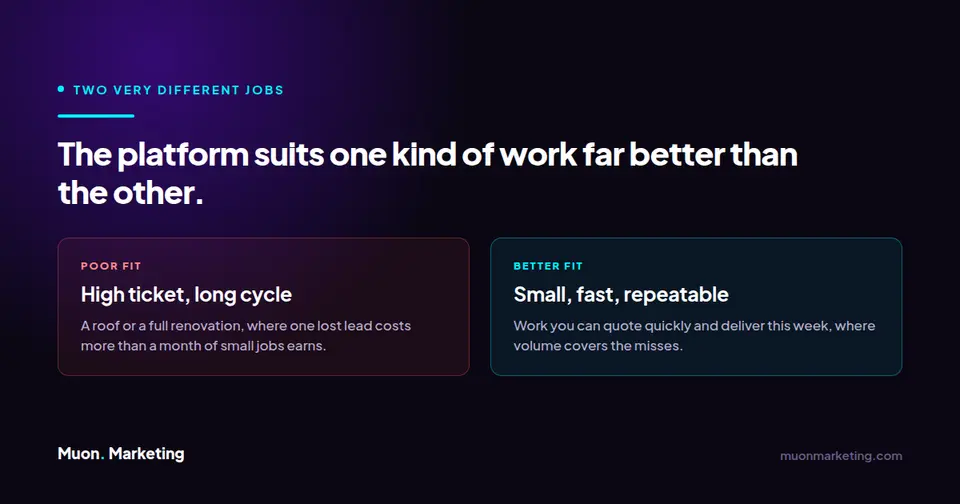
It suits small and fast far better than large and slow
Run the table again with a high ticket trade in mind and the problem becomes obvious. If you sell roofs or full renovations, you close a small fraction of enquiries, each lost conversation still costs you, and the losses accumulate faster than the wins pay for them. The model punishes long consideration cycles.
If you sell work you can quote quickly and deliver this week, the same model reads completely differently. Handyman work, cleaning, small repairs, single room jobs. Volume covers the misses, the conversion rate is higher because the decision is smaller, and the contact price is a sensible fraction of the ticket.
That is the honest summary. Thumbtack is a volume product. Judge it by whether your work is a volume business, not by whether the platform is good or bad, because the same platform produces opposite results in a cleaning business and in a roofing company.
How to test it without funding a season
Set the smallest budget the platform allows and treat the first month as a measurement exercise rather than a marketing campaign. You are not trying to grow, you are trying to learn two numbers.
The first is your contact to job rate on this specific channel, tracked separately from everything else. The second is your average job value from those wins, which is frequently lower than your overall average because platform customers skew price sensitive.
With those two figures the decision makes itself. If your effective cost per job sits comfortably below your gross margin on that job, fund it further. If it does not, you have learned that for the price of one month rather than one season.
Respond fast while you are testing, because response time dominates conversion on messaging platforms in a way it does not elsewhere, and it is the single thing that decides whether a shared contact is worth buying at all. If you cannot reply within minutes during working hours, the test will understate what the channel could do and you will draw the wrong conclusion.
What it does not build
Every conversation on the platform belongs to the platform. You are renting access to demand, and when you stop paying the demand stops the same day. That is fine as a bridge and poor as a destination, which is the same argument that applies to pay per lead versus a monthly retainer.
For a comparison point, since almost nobody publishes one: our performance model is $195 a month plus $10 to $65 per qualified lead depending on trade and market, where qualified means a tracked call or form submission meeting a definition agreed in writing beforehand. Ask for that definition wherever you are buying, and ask what happens when a contact does not meet it.
The work that keeps producing after you stop paying is the profile, the reviews and the answers you publish yourself, and whether you build that before or after you start advertising depends on how soon you need the work. The method is on the local SEO service page, and if you are already paying somebody to do it, you can check whether it is happening without asking them.
Thumbtack FAQs
Is Thumbtack worth it for contractors?
It depends almost entirely on your job size and speed. For small, fast, repeatable work where you can quote quickly and volume covers the misses, it frequently pays. For high ticket work with long consideration cycles, the charge on every contact accumulates faster than the wins cover, because you are paying for every conversation including the ones that end after one message.
When does Thumbtack charge you?
When a customer makes contact through the platform. That is the billable event, regardless of whether you reply, whether they reply back, or whether you ever win the job. It is not hidden and it is not a commission on completed work, which is the distinction contractors most often get wrong when pricing it mentally.
How do I work out whether it is profitable?
Divide the price of a contact by the share of contacts that become paid work. That figure, not the contact price, is your cost per job. Compare it against your gross margin on a typical job from that channel, and use the average job value from platform wins specifically, since it is often lower than your overall average.
Why does my conversion rate seem so low?
Messaging platforms attract browsing behaviour that phone calls do not, so a share of contacts are gathering quotes with no near term intention of hiring. Response speed also matters more here than almost anywhere else. If you are not replying within minutes during working hours, you are losing conversations you paid for.
Can I control what I spend?
You set a budget, which caps exposure but does not change the underlying model. The useful discipline is to start at the smallest budget available and treat the first month as measurement rather than growth, so you learn your contact to job rate and your average job value before committing further.
Should I use Thumbtack or build my own lead flow?
Both, in sequence rather than instead of each other. Platform contacts arrive this week and your own channel takes months. Cutting one before the other exists just leaves a gap. The number to watch is whether the share of work arriving without a platform fee is rising month on month.