
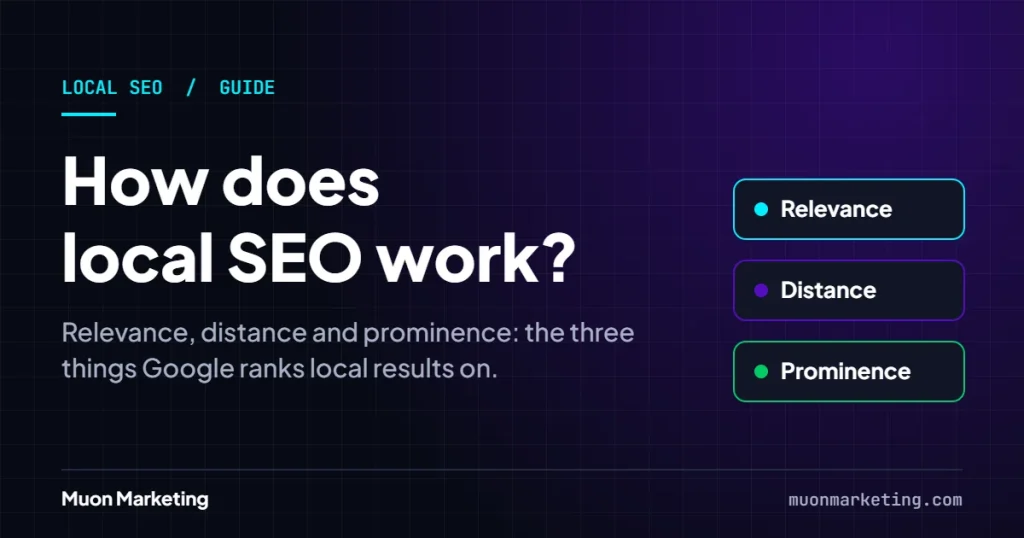
Local SEO works by giving Google enough proof to show your business when someone nearby searches for what you sell. Google ranks local results on three things: relevance, distance and prominence. You cannot move your building, so local SEO is the work of improving the other two through your Google Business Profile, your website and your reviews.
The rest of this guide explains each part in plain English: what Google looks at, what you can change, what you cannot, and how to tell whether it is working.
What does Google look at to rank local businesses?
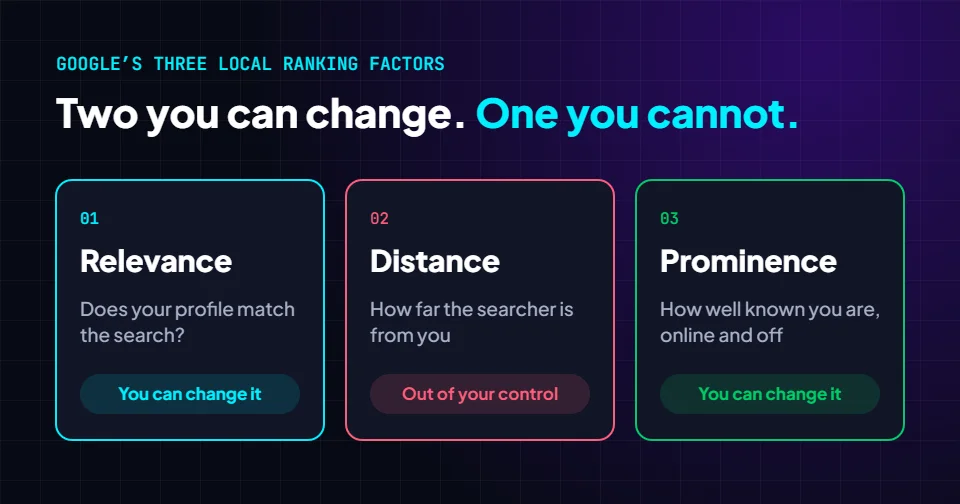
Google publishes the answer itself. Its guide to improving your local ranking says local results are based mainly on relevance, distance and prominence. Everything a local SEO company does should map back to one of those three.
| Factor | What Google means | What you can do about it |
|---|---|---|
| Relevance | How well your Business Profile matches what someone is searching for | Pick the right categories, list every service, and write a clear page on your website for each one |
| Distance | How far your business is from the person searching | Very little. You can set an accurate service area, but you cannot change where the searcher is standing |
| Prominence | How well known your business is, online and off | Earn reviews, reply to them, get listed on trusted sites, and publish pages other sites want to link to |
Most of the work sits in relevance and prominence. Distance is the one factor nobody controls, which is why the same business can rank well on one side of town and not appear at all a few miles away.
Is local SEO the same as regular SEO?
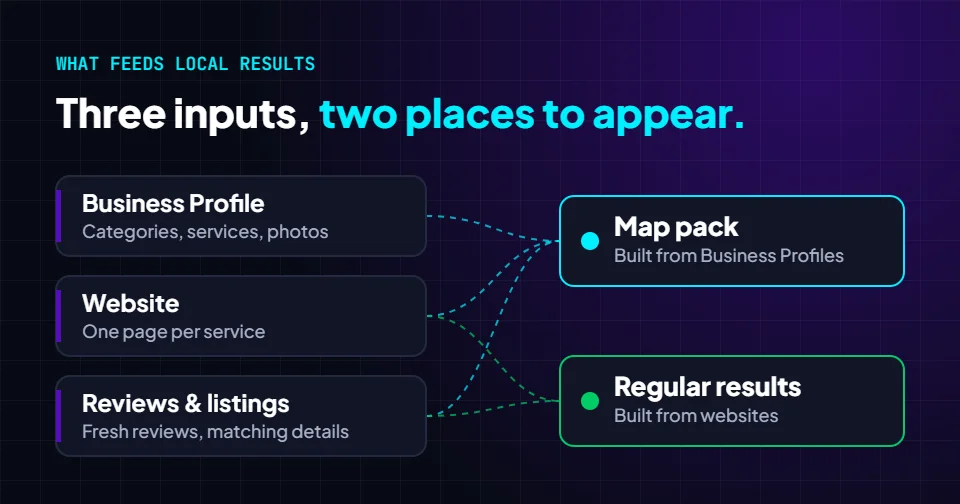
Not quite. A local search such as “plumber near me” usually shows two sets of results. At the top is the map with three businesses under it, often called the map pack. Below that are the regular website results.
The map pack is built from Google Business Profiles. The regular results are built from websites. Local SEO works on both, because a business that only shows in one of them is missing half the people searching. Regular SEO, the kind a national online store needs, mostly ignores the map.
The website side follows the same process Google uses for every site: it finds your pages, stores them in its index, and decides which ones answer a search. Google explains those steps in its guide to how Search works. If a page is never found or never indexed, it cannot rank anywhere, local or not.
What does your Google Business Profile do?
Your Google Business Profile is the listing that appears in the map and in the panel on the right of the results. For most local businesses it is the single biggest piece of local SEO, because it is what the map pack is made of.
Google says businesses with complete and accurate information are more likely to show up in local results. In practice, complete means:
- The right primary category, plus any secondary categories that genuinely fit
- Every service you offer, named the way customers search for it
- A service area that matches where you actually work
- Correct hours, phone number and website link
- Real photos of your work, your team and your vehicles or premises
Ownership matters too. If a past employee or an old agency controls the profile, you can lose it overnight. Our guide to managing access to your Google Business Profile covers who should own it and how to add people safely.
Why does your website still matter for local SEO?
Your website feeds both halves of local search. It is what ranks in the regular results, and Google reads it to judge how relevant your Business Profile is.
A local business website works best with one clear page per service and, where you serve several towns, pages that say something true about each place rather than swapping the city name. Every page should load fast, work on a phone and show the same business name, address and phone number as your profile. A site that lists one service on a single crowded page gives Google very little to match against.
How do reviews affect local rankings?
Reviews feed prominence. Google states that more reviews and positive ratings can help a business’s local ranking, and that replying to reviews shows you value the feedback.
Two things matter more than the star average. The first is a steady flow: a business that gets a few new reviews every month looks active, while one that got thirty reviews two years ago and none since does not. The second is replies. Answering every review, good or bad, is public proof that someone is paying attention.
Never buy reviews or offer something in return for a five-star rating. It breaks Google’s rules, and removed reviews or a suspended profile cost far more than the reviews were worth.
What are citations, and do they still matter?
A citation is any listing of your business name, address and phone number on another site: directories, industry associations, your chamber of commerce, review sites. Google uses them as a cross-check. When every listing agrees, Google has more confidence in your details. When they disagree, for example an old phone number on one site and a former address on another, that confidence drops.
Citations are rarely what moves a business to the top, but messy ones can hold a business back. Our post on local citation building explains which listings are worth having and how to clean up the old ones.
Why do my rankings change from one street to the next?
Because of distance. Google ranks the map results for the person searching, from where they are standing, so there is no single ranking for your town. You might be first for searches near your office and nowhere for the same search across the river.
This is why one screenshot of a search proves very little. A proper check runs the same search from a grid of points across your service area and shows where you appear on each. Our local SEO heat map guide explains how that kind of map is made and how to read it.
How long does local SEO take to work?
There is no fixed timeline, and anyone who promises one is guessing. It depends on how competitive your trade is in your area, what shape your profile and website are in today, and how much work goes in each month.
What tends to happen is an order rather than a date. Fixing a broken or incomplete profile can change things quickly. New pages need to be found and indexed before they can rank. Reviews and links build slowly, month by month. Impressions usually move before calls do, so they are the first sign of whether the direction is right.
How can you tell if local SEO is working?
Look at numbers you can check yourself, not only the ones in a report:
- Google Search Console: impressions and clicks for searches that include your services and towns
- Your Business Profile performance: calls, direction requests and website clicks
- Call tracking: how many calls came from search, and whether they were real customers
- A ranking grid run from the same points each month, so changes are measured the same way
If you already pay someone for this, our guide on how to tell if your SEO company is working walks through three checks you can run in about fifteen minutes.
What can local SEO not do?
Google is clear that there is no way to request or pay for a better local ranking. That rules out a lot of what gets sold as local SEO. No one can guarantee a top spot in the map, and no one can change how far a searcher is from your door.
What local SEO can do is remove the reasons Google has to show someone else: an incomplete profile, a thin website, inconsistent listings, a quiet review history. Fix those, keep them fixed, and you give Google every reason to show your business when it is a good match.
Local SEO questions
What is local SEO in simple terms?
Local SEO is the work of getting a business to show up when people nearby search for what it sells. It covers the Google Business Profile, the business website, reviews and directory listings, so that Google has clear, consistent proof the business is relevant and well known in its area.
What are the three main local ranking factors?
Google says local results are based mainly on relevance, distance and prominence. Relevance is how well a business matches the search, distance is how far it is from the person searching, and prominence is how well known it is, which includes reviews and links from other websites.
Do I need a website for local SEO?
A Google Business Profile can appear in the map without a website, but a business without one is missing the regular search results and gives Google less to judge relevance by. A simple site with one clear page per service and the same contact details as the profile makes local SEO work better.
Can I pay Google to rank higher in the map?
No. Google states there is no way to request or pay for a better local ranking. Google Ads and Local Services Ads can place a business in sponsored spots above the results, but those are paid ad placements, separate from the free map rankings that local SEO works on.
How many Google reviews does a local business need?
There is no set number. Google says more reviews and positive ratings can help local ranking, but what matters in practice is a steady flow of recent, genuine reviews and replies to them. Compare yourself with the businesses that appear above you for your main searches rather than chasing a fixed target.
Is local SEO worth it for a small business?
Local SEO is usually worth it for a business whose customers search for it nearby, such as trades, clinics and home services, because the map and local results are where those customers look first. It is less useful for a business that sells mainly online to customers anywhere in the country.
If you would rather have someone handle this for you, our local SEO service covers the profile, the website, reviews and listings on a flat monthly plan. You can also start with a free audit of your business and website.