
You are paying somebody every month and you cannot tell what you are getting. The reports arrive, the numbers point upward, and the phone rings about as often as it did a year ago.
Nearly every guide to this problem gives the same advice: ask your agency for a report, ask them what they did, ask them to explain the numbers. That advice has one obvious flaw. You are reading this because you do not fully trust the answers you are already getting, and asking the same source again does not fix that.
So here is the other version. Three things you can check yourself, in about fifteen minutes, without asking your agency for anything at all.
First, what the report is not telling you
Agency reporting is usually not dishonest. It is usually just built from the metrics that move most reliably, which are not the metrics that pay your bills.
| What the report shows | What it actually proves | What to check instead |
|---|---|---|
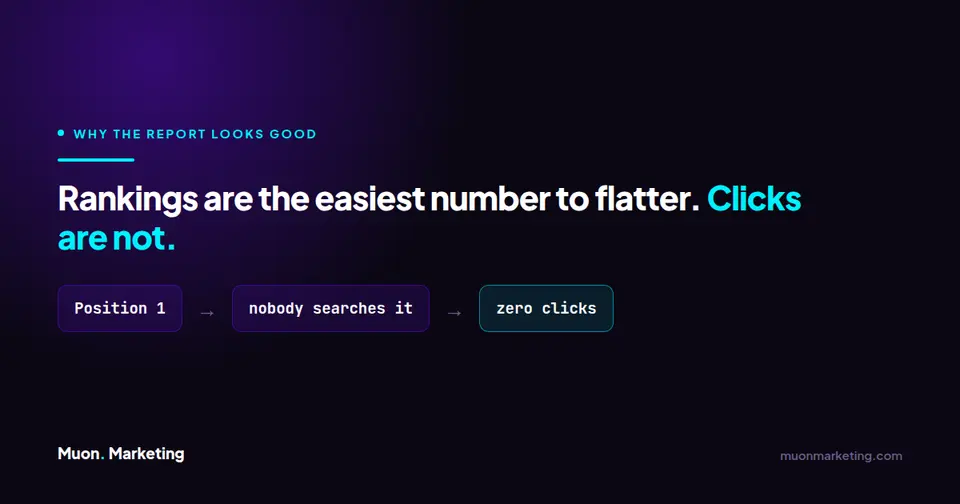
| Rankings improved for 14 keywords | Nothing on its own. Position 1 for a phrase nobody types is position 1 for nothing | Impressions in your own Search Console |
| Traffic up 32% | Nothing, if the growth is branded searches or bots. People searching your company name were going to find you anyway | Non-branded clicks specifically |
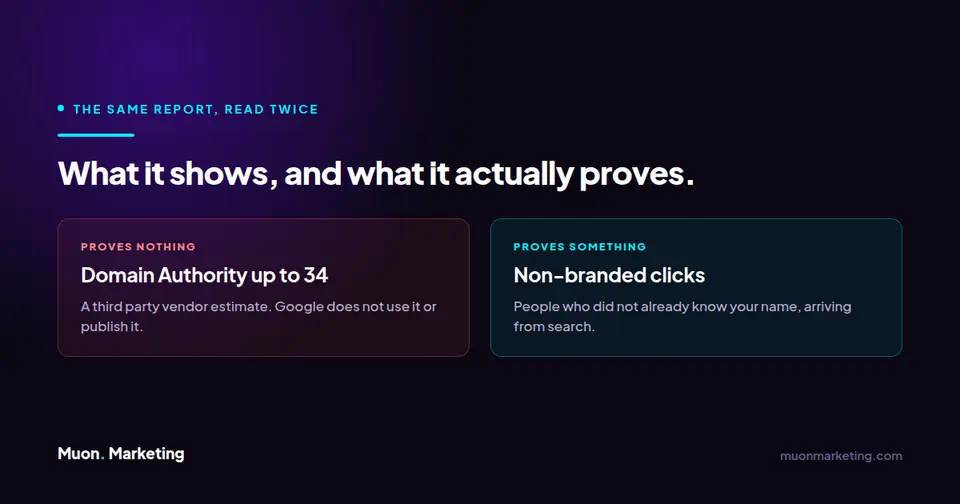
| Domain Authority up to 34 | Nothing Google uses. It is a third party vendor’s estimate, not a search engine metric | Clicks, which are real |
| 47 backlinks built | Possibly harm, depending where they came from | The list of referring domains, by name |
| Monthly reports delivered on time | That reports are delivered on time | Whether anything on the site actually changed |
Check one: your own Search Console, not their report
Search Console is Google’s data about your site, it is free, and it belongs to you rather than to the agency. If you do not have access to your own property, that is not an administrative detail to sort out later. That is the finding.
Once you are in, ignore rankings entirely and look at two numbers over the last six months: impressions and clicks.
Impressions tell you whether Google is showing your pages to anyone. Clicks tell you whether those people came. The gap between them is where most of the useful information lives. Rising impressions with flat clicks means you are being shown for things that are not you, or shown in positions nobody reaches. Flat impressions means nothing has changed at all, whatever the report says.
Filter out searches containing your business name. What is left is the work you are paying for.
Check two: look at where the results actually start
This is the one nobody tells you, and it explains a lot of otherwise baffling reports.
Search one of the phrases you are supposedly ranking for and look at the top of the page. On a great many searches the first ordinary result does not appear until you have scrolled past an AI summary, an ads block, a map and a stack of expandable questions. We measure this on every query before we write anything: on some searches the first organic result begins around 200 pixels down the page, and on others it does not begin until past 2,000.
Position 4 on the first kind of search is a real result. Position 4 on the second kind is invisible, and no amount of further optimisation will change that, because the problem is the shape of the page rather than the quality of your listing.
So when a report shows genuine ranking gains alongside no new enquiries, this is often why. It is worth knowing, because it turns the conversation from “you are not working hard enough” into “we are aiming at the wrong searches”, which is a fixable problem rather than an argument.
Check three: find out whether the site changed
Work that happened leaves marks. Work that did not, does not.
Open one of your important pages, right click, and choose View Page Source. Near the top you will find the page title and the meta description. Compare them to what the same page looked like six or twelve months ago, which you can see for free at the Internet Archive’s Wayback Machine.
If the titles, descriptions and page structure are identical to a year ago, then whatever the reports have been describing, it did not happen on your website.
The honest version of the answer
Sometimes all three checks come back clean and the phone still is not ringing. That happens, and it does not automatically mean you were cheated.
A page can be genuinely well built and still earn nothing because its title was written to persuade rather than to match what people actually type. Some markets are dominated by directories with budgets no small business will ever match. Some searches have no commercial intent behind them at all. Those are real explanations rather than excuses, and a good agency will tell you which one you are looking at instead of sending another chart.
We found the first one on our own site this month, which is an uncomfortable thing to publish. Every page describing what we sell had been live for months with zero impressions, while a guest post submission page nobody was promoting quietly picked up 31 clicks. It was not neglect and it was not technical. The pages were indexed, canonical and several thousand words each. The titles were simply conversion copy. One page was headed “Stop Posting Into the Void”, which is a good line that nobody has ever typed into a search box. We rewrote fifteen of them against the phrases people actually use, and we will know in a month whether it worked.
We mention it because it is the same check worth running on your site before assuming bad faith. That failure mode is common, it is fixable, and from the outside it looks exactly like laziness. Our guide to why your SEO is not working walks through the other usual causes.
What to do with what you find
If nothing has changed and nobody can explain why, you have your answer.
If you find real work aimed at unreachable searches, you have a strategy conversation rather than a firing. That one is often recoverable, and it is worth having before you start again from zero with somebody new.
Either way, take administrative ownership of your own accounts first: Search Console, Analytics, and your Google Business Profile. Agencies come and go, and the data should not leave with them.
If you would rather have someone else run these checks, our free website and business audit covers the same ground automatically, and how we charge for the work afterwards is set out in pay per lead versus a retainer. If you want the work itself, that is local SEO services.
Frequently asked questions
How long should I give an SEO company before expecting results?
Six months is the usual honest answer for competitive work, and three is reasonable for a site with obvious technical problems being fixed. What matters more than the calendar is whether impressions are moving. Impressions respond well before clicks and rankings do, so a flat impression line at four months is a warning that something is wrong with the direction, not just the timeline.
What if my agency will not give me access to my own Search Console?
Treat that as the answer to your question. The property describes your website and the data is yours. Agencies have legitimate reasons to manage access, none of which require excluding the owner. You can also verify a fresh property yourself through your DNS or your hosting control panel, which gives you the data going forward even if nobody cooperates.
Is Domain Authority a real measure of SEO progress?
No. Domain Authority is a score invented by a third party software company to estimate how a site might perform. Google does not calculate it, use it, or acknowledge it. It moves in response to links, which makes it convenient for reporting and close to useless for deciding whether the work is paying for itself. Clicks are the number that matters.
My rankings improved but nothing else did. What does that mean?
Usually that the ranked phrases have little or no search volume, or that the searches they rank for bury organic results below an answer stack. Both are worth checking directly. Search the phrase yourself and see where the first ordinary result actually begins on the page. If it is thousands of pixels down, your position is real and unreachable at the same time.
Should I fire the agency or ask them about this first?
Ask, but ask about specifics rather than in general. Bring the impressions chart from your own Search Console and one query where you rank well and get nothing. A capable agency will recognise the problem and explain it. An agency that responds with another summary of activity has told you what you needed to know.
Does any of this apply if I do my own SEO?
Yes, and the checks are the same. The Search Console comparison and the search result depth check are the two most useful things a site owner can do without any tools at all. The difference is that you already know whether the work happened, so the third check matters less.