

A WordPress maintenance plan is a recurring service that keeps the software behind your site current, backed up, monitored and working. The useful ones are defined by what happens when something breaks, not by a list of tasks. That is the question to ask any provider, and it is the one most of them answer badly.
What a Maintenance Plan Actually Covers
If you would rather run it yourself first, we published the full website maintenance checklist organised by frequency. Almost every plan on the market includes some version of the same list. The differences are in frequency, in who is accountable when an update goes wrong, and in whether anyone is actually looking at the site between updates.
| Task | How often | What happens if nobody does it |
|---|---|---|
| Core, plugin and theme updates | Weekly at minimum | Known vulnerabilities stay open on your site indefinitely |
| Offsite backups | Daily, retained for weeks | A hack or a bad update becomes unrecoverable rather than inconvenient |
| Uptime monitoring | Continuous | You find out the site is down when a customer tells you |
| Security scanning | Continuous | Malware sits undetected until Google flags the site |
| Database maintenance | Monthly | Tables quietly grow until the site slows or the host suspends the account |
| Performance checks | Monthly | Speed degrades gradually and nobody notices the drift |
| Content and fix requests | As needed | Small changes wait weeks, or never happen at all |
Why Doing the Updates Yourself Is Not the Same Thing
The common objection is reasonable: updates are one click, so why pay someone. The answer is in the data.
Patchstack recorded 11,334 new WordPress vulnerabilities in 2025, a 42% increase on the year before. 91% of them came from plugins, 9% from themes, and just six from WordPress core, all low priority. The risk in a WordPress site is almost never WordPress itself.
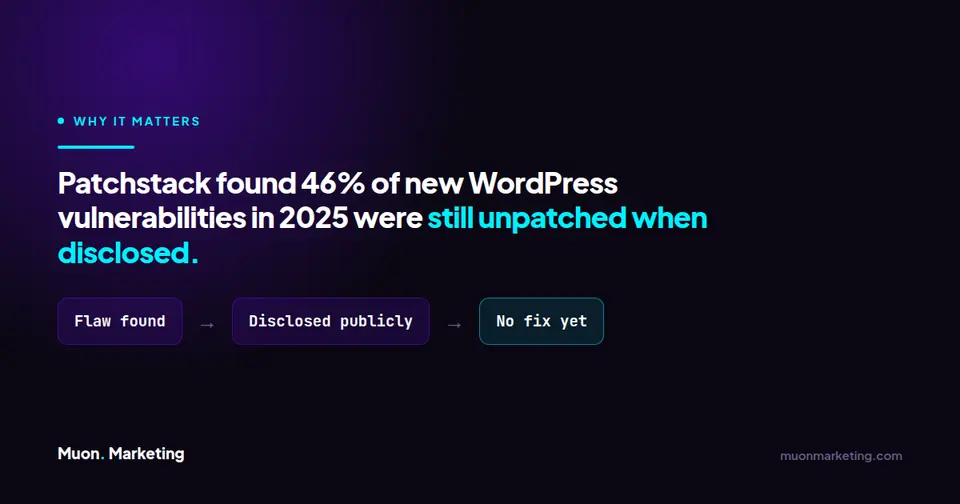
The number that matters most for this decision is different though. 46% of those vulnerabilities were still unpatched on the day they were publicly disclosed. The flaw was announced and no fix existed. Clicking update on a schedule does nothing about those, because there is nothing to install.
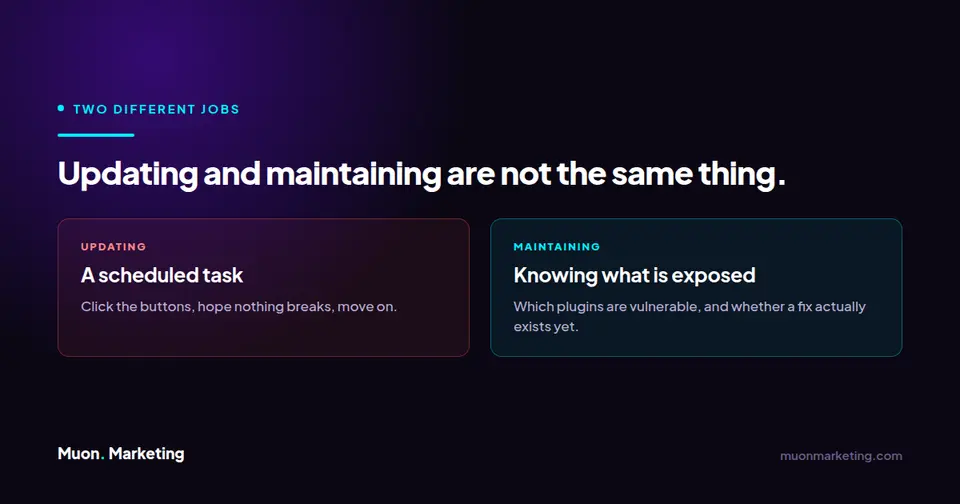
That is the real argument for a maintained site rather than an updated one. Updating is a task. Maintenance is somebody knowing which of your plugins is currently exposed, whether a patch exists, and what to do in the window where it does not.
What a WordPress Maintenance Plan Costs Per Month
For a small business site, most plans land between $100 and $300 a month. Add WooCommerce and the range moves to roughly $300 to $1,000. Maintenance-only care plans start lower, from around $39, and full service providers run well past $1,000. Those figures come from Codeable’s market survey of maintenance pricing.
That spread is wide because the plans are not the same product. Comparing two monthly figures without knowing what sits behind them is the mistake that makes cheap plans look like bargains. Pricing splits into three broad shapes, and the shape tells you more than the number.
| Model | Typical shape | What to watch for |
|---|---|---|
| Automated only | Low monthly cost, software runs the updates | Nobody looks at the site. When an update breaks a page, it stays broken until you notice |
| Maintenance plus support hours | Mid range, includes a change allowance | Check whether unused hours roll over, and what counts as a billable change |
| Managed service | Higher monthly cost, includes strategy and content | Only worth it if you would otherwise be paying separately for those things |
The same logic applies to how the wider marketing work is priced, which we cover in SEO retainer versus pay per lead. Two things are worth insisting on regardless of which shape you choose. Published pricing, so you can compare without a sales call. And month to month terms, because a provider confident in the service does not need a twelve month lock-in to keep you.
Muon Marketing publishes both. Our managed WordPress hosting and maintenance sits inside the Web Management tier, and the full breakdown is on the pricing page rather than behind a form. Month to month, cancel any time.
Is a WordPress Maintenance Plan Worth It?
It is worth it if the site takes bookings, takes payments, or would cost you customers while it is down. It is usually not worth it for a brochure site you would happily rebuild. The real test is not the monthly fee. It is what a broken checkout on a Saturday morning costs you, and how long it would stay broken with nobody watching.
Not everyone does, and it is worth being honest about that.
- Probably not: a small brochure site with three plugins, no forms, no ecommerce, and someone in the business who genuinely enjoys running updates and checking backups.
- Probably yes: the site takes bookings, payments or leads. Downtime costs money directly.
- Almost certainly yes: nobody has logged into wp-admin in three months and you are not sure when the last backup ran.
If the third one made you uncomfortable, that is the answer. The most common state we find on a first audit is not a hacked site. It is a site where something stopped running quietly, months ago, and nobody was watching.
What an Unmaintained WordPress Site Looks Like
These are not hypotheticals. They are the specific failures we write about because we keep finding them:
- Scheduled jobs stop running, and the WooCommerce sessions table grows into the gigabytes because nothing purges it.
- Background work backs up in the Action Scheduler queue, where failed jobs used to accumulate forever.
- Security logging is left on full, and the Wordfence traffic table becomes the largest object in the database.
- The hosting account hits its inode limit, and backups and uploads start failing silently.
Every one of those is cheap to prevent and tedious to fix after the fact. That gap is the entire value of a maintenance plan.
WordPress Maintenance Plan FAQs
What is a WordPress maintenance plan?
A recurring service that keeps your WordPress site updated, backed up, monitored and working. Typical inclusions are core, plugin and theme updates, offsite backups, uptime and security monitoring, database and performance checks, and an allowance for content changes or fixes.
Can I just do WordPress updates myself?
You can, but updating and maintaining are different things. Patchstack recorded 11,334 new WordPress vulnerabilities in 2025, with 91% coming from plugins, and 46% of them were still unpatched on the day they were publicly disclosed. For those, there is nothing to install. Handling that window is what a maintained site gets you that a scheduled update does not.
How much should a WordPress maintenance plan cost?
It depends on which of three shapes you are buying: automated updates only, maintenance plus a support allowance, or a fully managed service including strategy and content. Compare the shape before the number, and insist on published pricing and month to month terms rather than a sales call and a twelve month contract.
Does managed hosting include maintenance?
Usually not in the way people assume. Managed hosting covers the server, and often automatic core updates. It rarely covers plugin conflicts, database bloat, broken layouts after an update, or making the change you actually wanted this month. Check exactly where the host stops and you start.
What happens if an update breaks my site?
On a good plan, the provider restores from a recent backup and fixes the conflict, and you may never hear about it. On an automated-only plan, the update runs, the page breaks, and it stays broken until somebody notices. This single question separates most plans on the market.
How often should a WordPress site be updated?
Weekly at minimum for plugins and themes, since that is where 91% of vulnerabilities originate. Updates should be applied after a backup and followed by a check that the site still works, rather than fired automatically and left unverified.
If you are not sure when your site was last backed up, that is worth knowing before it matters. See what our maintenance covers, or tell us about your site and we will take a look.